
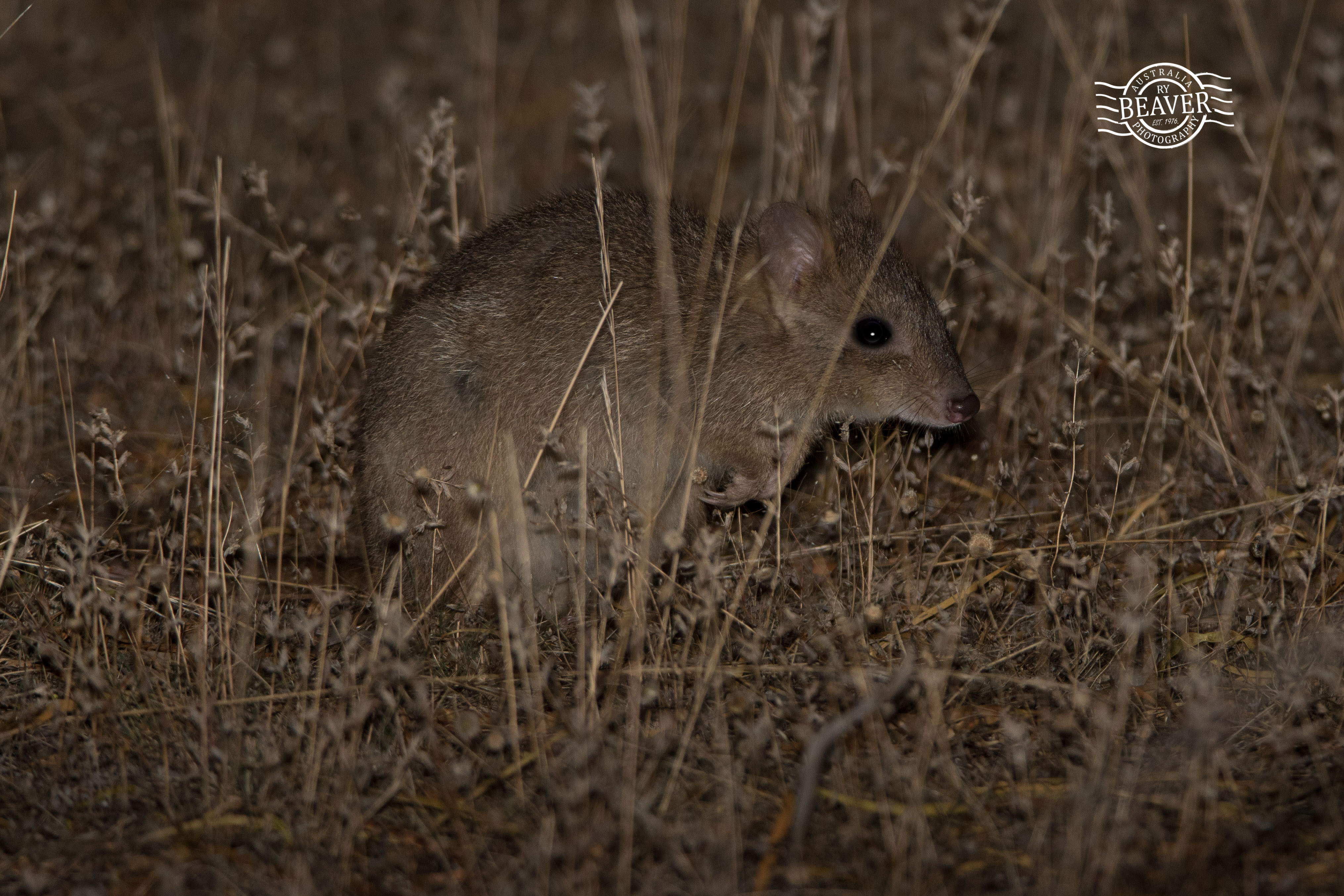
Bettongs belong to the family Potoroidae — the rat-kangaroos — a group of small, fast-moving marsupials closely related to kangaroos and wallabies. They are among Australia’s most ecologically important mammals, playing a critical role in turning over soil and dispersing seeds and fungi. Sadly they are also among the most threatened, having been devastated by foxes, cats and habitat loss since European settlement. Two species are covered here: the Woylie and the Burrowing Bettong (Boodie). Potoroos seen in Tasmania will be added to this page once those posts are published.
Woylie (Brush-tailed Bettong) — Bettongia penicillata
Woylie is both the common name and the Noongar name for this species — one of the few cases where the indigenous name has become the standard English name. The Woylie is a small, compact bettong with a distinctive brush-tipped tail. It was once one of the most abundant mammals in Australia, estimated at around 40 million individuals across the southern half of the continent. Fox control programs in the 1990s saw numbers recover dramatically, but a second catastrophic decline from the mid-2000s — the cause still not fully understood, with disease suspected — saw numbers crash again. Conservation status: Critically Endangered.
Like other bettongs, Woylies are important ecosystem engineers. They forage for underground fungi and truffles, turning over significant amounts of soil in the process — the ecological equivalent of having thousands of tiny ploughs working the bush floor every night.
Where to find Woylies
- Dryandra Woodland National Park — the best wild location. Found by spotlighting at night, particularly in the old Sandalwood plantations. They can be very timid and often the only photo opportunity is of them fleeing! See the Dryandra Spotlighting post for location advice, and the June 2026 family trip where one dashed in front of the car on Tomingley Road.
- Karakamia Sanctuary (AWC managed) — public spotlighting tours available. A fenced sanctuary in the Perth Hills.
- Whiteman Park — spotlighting tours available. Closer to Perth.
- Barna Mia Nocturnal Wildlife Experience — guided tours at Dryandra with multiple rare species in a large fenced enclosure. A great option if you want a guaranteed close encounter.


Burrowing Bettong (Boodie) — Bettongia lesueur
Known as the Boodie — a name recorded from multiple Aboriginal language groups including Noongar — the Burrowing Bettong is unique among Australian macropods in that it lives in burrows and warrens, sometimes in large communal systems. It was once one of the most widespread mammals in Australia, found across the southern two-thirds of the continent. It is now extinct on the mainland, persisting naturally only on three offshore WA islands: Barrow, Bernier and Dorre. Conservation status: Vulnerable.
The disappearance of Burrowing Bettongs from the mainland is largely due to predation by feral cats and foxes. The story of their decline is one of the starkest examples of what introduced predators have done to Australia’s native fauna — a species that once numbered in the millions reduced to a handful of island refuges.
The good news is that conservation translocations have been successful. AWC has established populations in large feral predator-free areas at Scotia, Newhaven and Yookamurra Wildlife Sanctuaries and on Faure Island in Shark Bay. The total population across wild and managed sites is now estimated at over 30,000 animals — a genuine conservation success story, though ongoing management is essential.
Where to see Burrowing Bettongs
- Barna Mia Nocturnal Wildlife Experience, Dryandra — the most accessible option for most people. Guided night tours in a large fenced enclosure that houses Burrowing Bettongs alongside other rare species.
- Barrow, Bernier and Dorre Islands — the wild natural populations. Remote and access is restricted; not a realistic option for most wildlife watchers.
Gilbert’s Potoroo (Ngilkaat) — Potorous gilbertii
Known in Noongar/Menang as Ngilkaat, the Gilbert’s Potoroo is a potoroid of extraordinary conservation significance. It was thought to be extinct for over 100 years before being rediscovered at Two Peoples Bay Nature Reserve near Albany in 1994 — one of the most remarkable wildlife discoveries in Australian history. It is now considered one of the world’s rarest mammals, with only a tiny population surviving at Two Peoples Bay and a small translocated group on Bald Island. I have not seen one myself — encounters outside formal survey work are extremely rare — but the story of its rediscovery is extraordinary and worth reading about via the Gilbert’s Potoroo Action Group. The nearby Two Peoples Bay post covers what it’s like to visit the reserve.
Bettongs FAQ
What is a Woylie?
The Woylie (Brush-tailed Bettong, Bettongia penicillata) is a small nocturnal marsupial roughly the size of a rabbit, with a distinctive black-tipped brush tail. It is Critically Endangered and now restricted to a handful of conservation reserves in WA, including Dryandra Woodland. It was once one of the most abundant mammals in Australia.
Why are bettongs important to the ecosystem?
Bettongs are ecosystem engineers. Their constant digging for underground fungi and tubers turns over enormous amounts of soil, improving water infiltration and nutrient cycling. They also disperse fungal spores as they move through the bush, which helps the mycorrhizal networks that trees depend on. Losing bettongs from an ecosystem has measurable negative effects on vegetation health.
Where is the best place to see a Woylie near Perth?
Dryandra Woodland National Park is the most reliable wild location, about 2.5 hours from Perth. Karakamia Sanctuary in the Perth Hills runs public spotlighting tours and is much closer to the city. Barna Mia at Dryandra offers guided tours with guaranteed encounters in a fenced enclosure.
Are there Burrowing Bettongs in WA?
The last wild natural populations are on Barrow, Bernier and Dorre Islands off the WA coast. They are extinct on the WA mainland. However, AWC has successfully reintroduced them to several fenced sanctuaries across Australia, and Barna Mia at Dryandra is the most accessible place to see them in WA.
Like this photo? Woylie prints are available
Woylie prints are available to order — paper, canvas, metal, acrylic or framed, shipped anywhere in the world. Prints from US $2.
Further Reading
- Dryandra Spotlighting — Mammal Heaven — Woylies in the sandalwood plantation
- Dryandra with the Kids — Numbats, Mardo, Echidnas and a Near-Miss Woylie
- Mainland Quokka at Two Peoples Bay — also home to the Ngilkaat (Gilbert’s Potoroo)
- Dasyurids — Numbats, Quolls and Phascogales — other threatened WA marsupials
- Where to See Wildlife in Western Australia — full location index
You can also follow along on Facebook and Instagram for more regular updates between posts.
Page last updated August 2026.