
A family trip from January 2023 — Part 2 of 3
After two extraordinary nights on Bruny Island (Part 1), we headed back to Hobart and then east to Swansea. But not before I headed out alone to one of Hobart’s best-kept wildlife secrets — and Maria Island delivered a moment that made Sienna’s trip.
Waterworks Reserve, Hobart — A Solo Night Out
After two nights on Bruny we took the ferry back to Kettering and drove back to Hobart — Discovery Park again for two nights, which gave me a base to try somewhere I’d been reading about: Waterworks Reserve in South Hobart.
I ventured out alone on the night of January 6th — 9:30 to 11pm, 11 to 14 degrees, slightly overcast. The reserve is an easy drive from central Hobart, the gates close at 9pm but there’s pedestrian access with parking outside here, and the word online was that it held some good nocturnal mammals. I’d noted in my research: Eastern barred bandicoot, Tasmanian bettong.
I want to say something about solo nocturnal wildlife watching in unfamiliar places. There’s a particular atmosphere to it — you’re in the dark, in a place you don’t know, scanning for movement with a spotlight & thermal, and the bush has that quality of being full of things just outside the beam. Waterworks Reserve at night is, as I wrote in my notes, “bit eerie at night on own.” It’s a large, quiet reserve with big eucalypts, open grassy areas and good understorey with bodies of water, and once you’re in past the gate the suburb disappears completely.
It was worth every slightly eerie minute.
First up: A single common ringtail possum (Pseudocheirus peregrinus) in a tree just next to the carpark — always good to see. Different colouration, distribution and conservation status from my usual Western ringtail possum (Pseudocheirus occidentalis) which is critically endangered. On the eastern side of Australia they do quite well in urban environments.

I then entered into the reserve and saw an abundance of marsupials. Lots of Common brushtailed possums (Trichosurus vulpecula) in the trees, Bennett’s wallabies (Notamacropus rufogriseus) and Tasmanian pademelons (Thylogale billardierii) on the grass areas.


Then I spotted an Eastern barred bandicoot (Perameles gunnii) – my target species – just under a picnic table, excavating their characteristic conical diggings in the grass. These are another mainland extinction — the eastern barred bandicoot survives in the wild in Tasmania and a small managed population in Victoria which was ‘extinct in the wild’ until recently. On the mainland it was devastated by foxes and is functionally extinct in the wild outside managed programs. Here in a suburban Hobart reserve it was going about its business entirely unbothered by me. Lifer number seven!


Then something smaller, faster and more ambiguous: what I believe were Tasmanian bettongs. Two or three of them — smaller than pademelons, light fawn colour, moving with that distinctive hunched bettong gait that I know from woylies back home. I wrote: “smaller than pademelon — light fawn colour + moved like woylie.” No photos unfortunately — they were quick and dashed uphill into undergrowth. I can’t call it with 100% certainty, but everything I saw was consistent with Tasmanian bettong (Bettongia gaimardi): size, colour, movement and habitat. I’ll take it as a probable but wish I got a better look and better yet a photo to confirm.
The thermal shot shows just how many animals were at Waterworks reserve – mostly pademelon and Bennett’s but some bandicoots as well – it was like this on every grassy area.


Another Eastern barred – so pleased to have confirmed this was a great sight for them.

I drove the road through the reserve afterwards looking for more eastern barreds – found one more, not far from the warning sign and then headed back to the cabin very pleased with myself.

Salamanca Markets and the Drive North-East
Day four in Hobart brought a very different kind of exploration — Salamanca Markets on a summer Saturday morning with the family. If you haven’t been, Salamanca is one of Australia’s best markets: great food, local producers, the historic sandstone warehouses as a backdrop, and a genuinely festive atmosphere. The kids were in their element. Mel was in her element, sampling salmon direct from Tassal’s. I was happy they were happy.
We did head up to the summit of kunanyi / Mount Wellington – it sits prominently watching over Hobart. You can drive a windy road all the way to the very top, no mountain climbing required. Spectacular views and we saw a lyrebird (introduced from the mainland) cross the road on our way up. Quite different vegetation and noticeably colder at the top (stands at an elevation of 1271 metres)

After a couple of days in Hobart we drove two hours north-east to Swansea on the east coast, checking into Swansea Cottages for four nights. The east coast of Tasmania in January is spectacular — clear water, white beaches, dramatic coastal scenery. We were here primarily for the beach and relaxation, but with Maria Island just across the water, I had a wildlife agenda too. The kids and I went swimming – lovely views across the bay to Freycinet National Park.

Maria Island – wombats for us
Maria Island is one of those places that becomes instantly legendary once you’ve been there. No cars, no shops, just national park. The ferry drops you at the old convict settlement of Darlington and you’re on foot from there. I had heard the wildlife is extraordinary: wombats wandering through the historic buildings, Cape Barren geese on the lawns, Forester kangaroos in the bush, the reintroduced Tasmanian devils on the island.
We spotted an Echidna on the road not far out from Swansea, but it dug into blackberry bushes, so we were not able to get a good look as they are much hairier and look less spiky than the west coast version.

We took the 35-minute ferry from Triabunna on January 7th, a warm day at around 20 degrees. The ferry staff told us the wombats hadn’t been very visible over the last few days due to the heat, but today was slightly cooler and overcast — good wombat conditions we hoped!

Getting off the ferry at Darlington, we were immediately greeted by Cape Barren geese — large, grey, imperious, completely unintimidated by humans. The kids thought they were wonderful and slightly alarming in equal measure.

They’ve been reintroduced to Maria Island and are now a prominent feature of the settlement area. We also had a good look at the massive whale bones – not sure of the species – remnants of past whaling activities.

We walked straight towards the historic buildings — the old penitentiary, the convict probation station — keeping our eyes on the grass areas for wombats – spotting the cuboid poos!

We saw a large burrow – evidence of them!

We headed for the track inland – seeing a nice Bennett’s wallaby munching the grass.

Also a number of our friends the Turbo chicken (Tasmanian native hen).

We walked the fossil cliffs track — spectacular sea cliffs with marine fossils visible in the rock face, a family favourite.


We also saw Forester kangaroos in the bush — the endemic Tasmanian subspecies (Macropus giganteus tasmaniensis) of the eastern grey, large and impressive in the grassland. They are the largest Tasmanian marsupial.

We also saw a Wedge-tailed eagle, an endemic subspecies (Aquila audax fleayi), in Tasmania – it was circling around presumably looking for food.

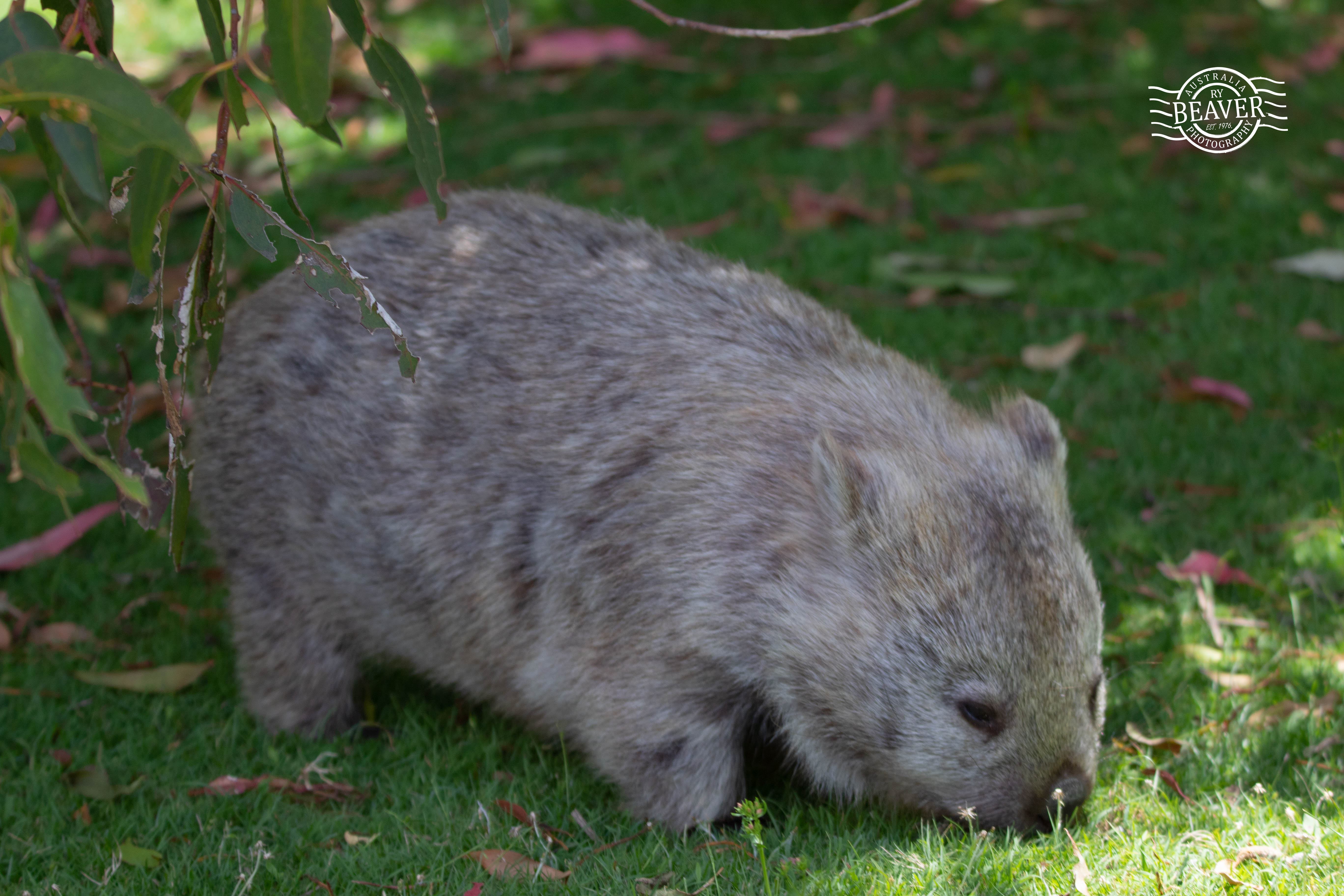
We sat down waiting for the ferry, pretty tired after our very long walk without seeing a wombat. The staff had mentioned it was a warm day for wombats to be out during the middle of the day, so part of me wasn’t surprised, but we were all a little disappointed. I decided to head back to the ruins and soon enough I saw a group of people looking at something – wombat! They are Flinders Island wombats, a unique subspecies – Vombatus ursinus ursinus – slightly smaller and greyer than their counterparts on the Tasmanian mainland.
Grazing on the grass, completely unhurried, doing exactly what wombats do — moving with that purposeful rolling waddle, ignoring the people watching entirely. I excitedly called Mel on the mobile saying I know you are tired but…… I found them!
When the family arrived, Sienna’s reaction made the whole day. She was six years old and a wombat had just appeared out of the bush and started grazing ten metres away. Another of them was a female with a joey alongside, and Sienna stood completely still watching them, muttering “it’s so cute”!

Yes, they are actually real after seeing many soft toy versions in the shops.


The kids watching the wombats.
We left Maria Island on the ferry thoroughly pleased that in the last 30 mins of our day we saw what we wanted to see! We were pretty tired after a good long walk but exhilarated as well.

A Note on Maria Island’s Wildlife History
Maria Island is a fascinating conservation story. When it was declared a national park in the 1970s, several species had already been lost from the island. Between 1965 and 1971, Parks and Wildlife conducted one of Australia’s most ambitious wildlife reintroduction programs, introducing 43 echidnas, 55 eastern barred bandicoots, ~30 wombats, 61 common ringtail possums, 136 long-nosed potoroos, 123 Tasmanian bettongs, 127 Bennett’s wallabies, 45 Forester kangaroos and more — many of them species now restricted to Tasmania and extinct on the mainland. In 2012 & 2013, 28 Tasmanian devils were introduced to the island as an insurance population against the spread of Devil Facial Tumour Disease. Unfortunately they have taken a liking to the taste of little penguins showing what a difficult balance conservation can be.
The Flinders island wombats (a sub-species of the common wombat) that we loved seeing are the direct descendant of one of those wombats introduced in the 1960s. The whole island is, in a sense, a living conservation success story.
Swansea bandicoot
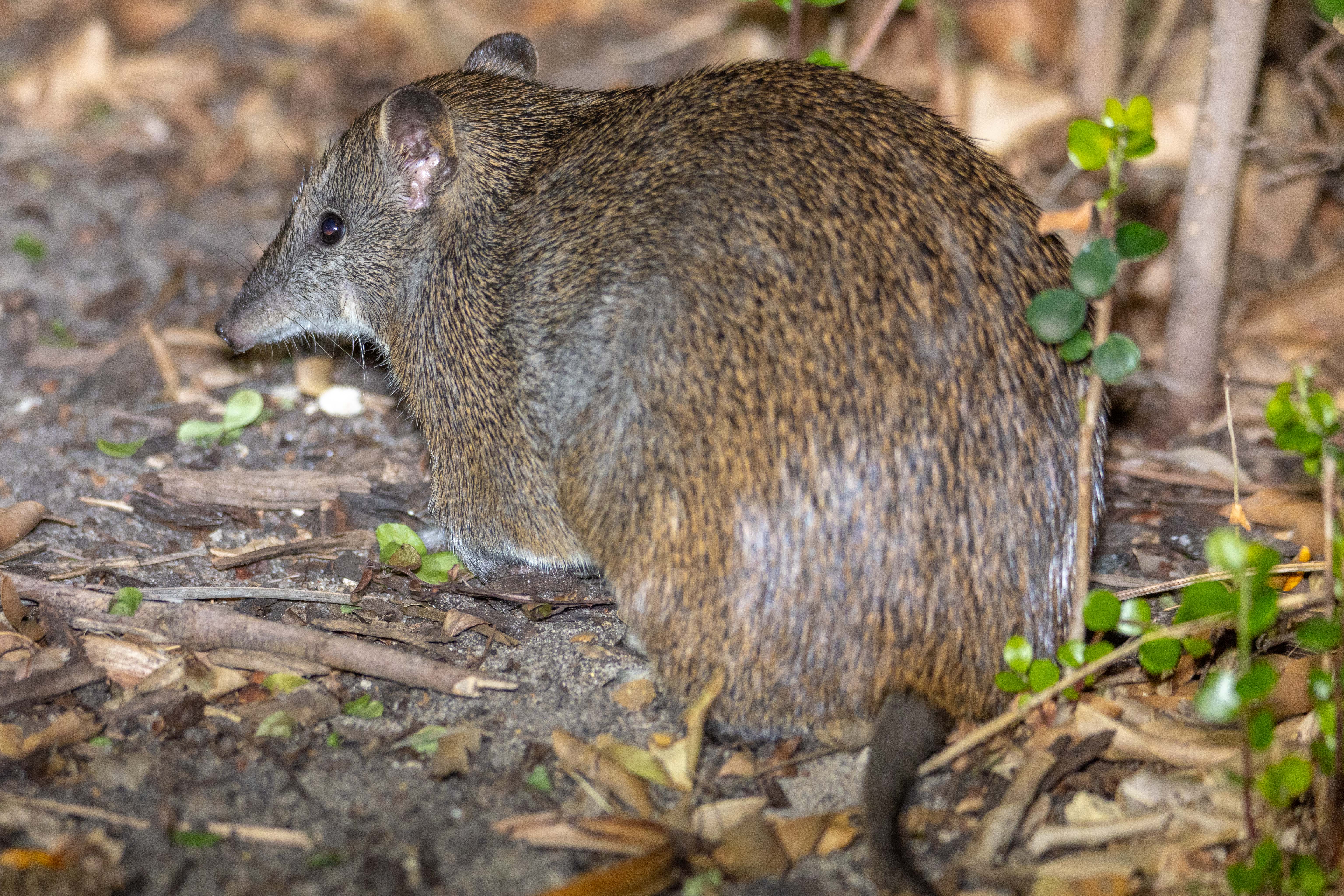
Back in Swansea that evening, we had a Southern brown bandicoot (Isoodon obesulus) visit us. Sienna spotted it outside the window of our accomodation munching away and we were able to watch it for a long time.

They are the same genus as the Quenda we get on the west coast but in WA they are now recognised as their own distinct species. We got a tip just as we were leaving that bandicoots are very common on the Swansea golf course at dusk – shame, it would have been nice to check this out (I am not sure of what permissions are required for access).
I also spotted a European rabbit (introduced feral) on the driveway of our accomodation.

Freycinet National Park
We also went to Freycinet National Park and enjoyed the amazing scenery and got a chance to snorkel and swim.

The views from the lighthouse were spectacular.

Not far from the lighthouse we found this White’s Skink (Liopholis whitii) on a rock, partly shaded.

We also saw some Long-nosed Fur Seal (Arctocephalus forsteri) on a distant rock.

I had a chance to get the drone out for some photography at Swansea – the distant outlines of Freycinet National Park can be seen.


The next stage of our trip was a part I was really excited about – we were heading to the western side of Tasmania that is much less populated and we had some good information on some more wildlife.
Coming in Part 3: A great spot for daytime platypus. The mountain wilderness of Loongana delivers platypus, Tasmanian devils, a spotted-tail quoll, glow-worms, a pink robin and yellow-tailed black cockatoos — before we drive home via Cradle Mountain.
Species added in Part 2:
- Eastern barred bandicoot — LIFER
- Tasmanian bettong (probable) — LIFER
- Common wombat — LIFER
- Cape Barren goose
- Long-nosed fur seals
- Forester kangaroo — LIFER sub-species
- Southern brown bandicoot
Tasmania Part 2 – Waterworks Reserve and Maria Island FAQ
Where can you see wombats on Maria Island?
Wombats are most reliable around the grassed areas near the Darlington settlement, especially near the old convict buildings and the tree line above them. They’re most active in the cooler parts of the day – overcast, mild conditions work best. Look for large burrows as a sign they’re in the area and ask others or staff for recent sightings.
How do you get to Maria Island?
A 35-minute passenger ferry runs from Triabunna, on Tasmania’s east coast. There are no cars on the island – everything from the old convict settlement at Darlington onward is on foot or bike.
Is Waterworks Reserve safe to visit alone at night?
It’s a quiet, well-used reserve close to central Hobart, with pedestrian access even after the vehicle gates close at 9pm. That said, solo night walks in an unfamiliar reserve always warrant care – stick to formed tracks and let someone know your plans.
What nocturnal mammals live at Waterworks Reserve?
Eastern barred bandicoots are the highlight – a species extinct on the mainland outside managed programs, but present in numbers here. Tasmanian bettongs are also reported in the reserve however my experience was they were very skittish and I didn’t experience a confirmed sighting, along with the usual Bennett’s wallabies, pademelons and possums.
Why does Maria Island have so many species not found elsewhere in Tasmania?
Between 1965 and 1971, Parks and Wildlife ran an ambitious wildlife reintroduction programs on the island, releasing species like wombats, bettongs, potoroos and Forester kangaroos – many now extinct on the mainland. Tasmanian devils were added later, in 2012-2013, as an insurance population against disease.
You can also follow along on Facebook and Instagram for more regular updates between posts.

Leave a Reply