

This post is a little different from my usual trip reports. Rather than telling the story of what I found on a particular night, this one is about what used to be here – and what we’ve lost. With Western Australia approaching its bicentennial in 2029, I’ve been thinking a lot about what that anniversary means. For many it will be a celebration of 200 years of settlement and the building of a society. For others – particularly Noongar people – it marks 200 years of profound disruption, dispossession and ecological loss. Both things are true, and I think it’s worth sitting with that complexity. I also think anyone who loves wildlife in this part of the world owes it to themselves to understand what was here before.
I acknowledge that this story takes place on Whadjuk Noongar boodja. For tens of thousands of years, Noongar people have cared for this country – managing, naming, and living with its animals and plants through deep ecological knowledge that shaped the very landscapes we now walk through.
The Noongar names for the animals in this post pre-date European settlement by thousands of years – they reflect a depth of ecological knowledge and relationship with country that no Latin binomial or English common name can capture. I have been using Noongar names in my wildlife writing for some time, but a recent bush walk led by Noongar language teacher Dylan Collard was a good reminder of just how important that language is, and how much is at risk of being lost. Early European settlers frequently misidentified and misnamed the animals they encountered – the quokka dismissed as a rat, the echidna baffling naturalists for decades – while Noongar people had named, understood and lived alongside these creatures for an unimaginably long time before anyone arrived from Europe. Dylan suggested I contact local Elders Roni and Simon Forrest to seek permission to include Noongar stories about the fauna of Boorloo, and I have done so. Noongar stories belong to Noongar people and it is not for me to include them without permission. This post is published as NAIDOC Week 2026 draws to a close – a week that celebrates the history, culture and achievements of Aboriginal and Torres Strait Islander peoples. This article has been developed over a number of years and I wanted to share it. If you’d like to learn more about Noongar culture and country, the links in the sources section are a good starting point.
Noongar boodja – country covers the entire south-western portion of Western Australia. The boundary commences on the west coast at a point north of Jurien Bay, proceeds roughly easterly to a point approximately north of Moora and then roughly south-east to a point on the southern coast between Bremer Bay and Esperance. There is no evidence that there has been any other group than Noongar in the south-west. Archaeological evidence establishes that we Noongar – alternative spellings: Nyungar/Nyoongar/Nyoongah/Nyungah/Nyugah and Yunga – have lived in the area and had possession of tracts of land on our country for at least 45,000 years
www.noongarculture.org.au (visited on 03/07/2024)

Boorloo and its original inhabitants.
According to Ngoongar custom they have always lived in South-western Australia since time immemorial. Archaeological evidence indicates that Noongar people have inhabited the southwestern region of Western Australia for at least 45,000 to 50,000 years. As the map above shows a rich culture of family groups living sustainably off the land.
They moved through it depending on the cycle of six seasons which they observed. The seasons are not locked to specific months like the European 4 seasons but as the signs were observed in the weather and the subsequent responses from plants and animals on which they depended. I think its a much more accurate representation of the seasons we experience in Perth.

The Noongar people have 14 different language groups and spelling of words can be variable as language was purely verbal prior to colonisation. More about the people and the language can be found in these websites – Noongar Boodjar & Noongar.org.au.
The First Europeans and Their Astonishment
Before we get to 1829 and the founding of the Swan River Colony, I want to start even earlier – because the story of European encounters with WA’s wildlife is, in its early chapters, a story of pure astonishment.
The Dutch were the first Europeans to set eyes on what we now know as Western Australian marsupials. In 1629, the crew of the Batavia – stranded on the Abrolhos Islands after their ship wrecked – encountered the local Tammar wallabies and used them as a food source. They not only ate them but also observed, apparently in bewilderment, that the young seemed to grow directly from the teat. The idea of a pouch animal was so utterly foreign to European experience that even learned ships’ doctors at the time promoted the theory that the young developed on the nipple itself – a fallacy that, as L. Glauert drily noted in his 1948 presidential address to the Royal Society, “is dying hard, as even today there are bushmen in the outback who are still of the same opinion.”
In 1658, a Dutch account of the voyage of the Waeckenboey described seeing on Wadjemup (Rottnest Island) “a wild cat resembling a civet-cat, but with browner hair” – undoubtedly the quokka, which still lives there today. Also Vlamingh – mistaking the same animal for “a kind of rat as big as a common cat” – gave the island a name that has stuck ever since: Rotte Nest, or Rats’ Nest unaware of its pre-existing Ngoongar name Wadjemup.
Vlamigh visited and named the Swan River (unaware of the pre-existing Ngoongar name Derbal Yerrigan) on 10 January 1697 (Zwaanenrivier in Dutch on account of the large amount of the birds) on a rescue mission looking for Ridderschap van Holland ship that had gone missing two years earlier.

I find something both funny and poignant about that. The quokka has gone from “rat” to the most photographed animal on social media in the space of three centuries. But what the Dutch accounts also tell us is that Rottnest Island was, even in the 1600s, a place where these animals were clearly thriving – which is exactly why they persist there today. No foxes, no cats, limited clearing. The island that European sailors dismissed as a rat-infested nuisance turned out to be a refuge.

Three years after de Vlamingh’s Rottnest visit, William Dampier landed on Dirk Hartog Island and described seeing “a sort of Racoon different from those of the West Indies chiefly as to their legs; for these have very short Fore-Legs, but go jumping upon them as the others do and like them are very good meat.” This is almost certainly a Tammar wallaby. Dampier’s account was widely read in Europe and contributed to the growing fascination with Australian fauna – a fascination that would eventually bring collectors, naturalists and scientists to these shores in numbers.
By the early nineteenth century, French expeditions were documenting species from the Perth region. The Geographe and Naturaliste arrived in 1801, and the botanical and zoological collections they made were extraordinary. Many of the Latin names attached to WA marsupials – the eugenii of the Tammar wallaby, the brachyurus of the quokka – date from French naturalists of this period who described specimens collected near what is now Perth.
These ongoing French visits probably were the driving force for the British colonisation of Albany in 1826 and then a few years later what was to become Perth as previously the settlements had all been in the Eastern Australia.
A Managed Landscape, Not a Wilderness
Here’s something that took me a while to really understand. When the first British settlers arrived at what they named the Swan River Colony in 1829, they did not step into a wilderness. They stepped into a managed cultural landscape. They documented thriving family groupings and clans, such as Munday’s family in the Beeloo District and Midgegooroo and his son Yagan in the Beelier district (see map above).
Boorloo – the Noongar name for the area around Perth – was a living system shaped by human hands over thousands of generations. Noongar people moved through their country in seasonal patterns, following the resources: fish runs, flowering plants, game animals. They used fire deliberately and skilfully to open feeding grounds, flush animals, encourage regrowth, and maintain the mosaic of habitats that different species needed at different times of year.
Boorloo was mostly wetlands as can be seen by the below illustration of the Perth CBD from 1835 looking over from what is now Claisebrook cove – use the slider to see a representation of the modern view. For more see article.


The wetlands of the Swan Coastal Plain were central to this. Places like Mardalup (now Claisebrook Cove), Boodjamooling (Herdsman Lake), and the vast chain of lakes and swamps that once stretched along the coastal plain from north to south were productive, complex systems. They provided food – gilgie (freshwater crayfish), yaakin (long-necked turtles), kooyar (frogs), djerap kep-ak (waterbirds), djildjit (fish) – and they supported the dense thicket vegetation along their margins that sheltered small mammals. Of the roughly 1,500 wetlands that once existed on the Swan Coastal Plain, more than 80 per cent have been drained, filled or so severely degraded as to be functionally lost. When you look at a Perth suburb today, there is a very good chance you are standing on what was once a wetland.

The image below depicts the foundation of Perth and mature Jarrah trees can be seen all around and in the background the Swan River with the tip of the Narrows nearly touching the other bank where the start of Mt Eliza, Kings Park. This painting was commissioned to celebrate the founding of Perth on 12 August 1829 at the site on a small hill where the Perth Town Hall is today. In present day this is all high rise buildings and bitumen roads.

Fauna of Boorloo
The animals had Noongar names long before they had Latin ones, some of which are below.
- Yongka (western grey kangaroo)
- Kwokka (quokka)
- Woylie (brush-tailed bettong)
- Boodie (burrowing bettong)
- Noombat (numbat)
- Dalgyte (bilby)
- Ngwayir (western ringtail possum)
- Koomal (brushtailed possum)
- Djooditj (Chuditch/Western quoll)
- Noolbenger (Honey possum)
These are not translations – they are original naming systems that reflect tens of thousands of years of close observation, ecological familiarity, and relationship. When John Gilbert arrived in the Swan River district in the 1830s collecting specimens for John Gould, he recorded Noongar names alongside the specimens and found them often the most reliable guide to identification. One positive in WA is that many Noongar names are used as common names for our fauna. Spelling of names can vary as Noongar was originally an oral language, with no written form prior to colonisation e.g. Noongar as spelling variations – also spelled Nyungar, Nyoogar or Nyoongah. DBCA (Department of Biodiversity, Conservation and Attractions) have this publication from 2001 which details 1100 Ngoongar names of mammal species which were recorded.

Sketch Of The Town Of Perth From Perth Water, Western Australia c1839 (Charles Dirk Wittenoom)


The point I keep coming back to is this: the abundance of wildlife that early settlers encountered was not accidental. It was the product of a land management system that had been refined over an enormous span of time. When that system was disrupted – when Noongar people were removed from country, cultural burning stopped, and the land was fenced, grazed and cleared – the ecological consequences were swift and severe.
Most of my sources for this article are from European sources as that is what I could access. I would love to incorporate oral history fromNgoongar people or be able to point to sources where it is accessible.
What Was Actually Here
So what did this landscape look like in terms of its wildlife? The records we have – early collector manifests, naturalists’ journals, Glauert’s meticulous trawl through the historical literature – paint a picture that is genuinely astonishing if you’re used to looking at the Perth landscape today.

Numbats noombat (Myrmecobius fasciatus) – now restricted to a handful of reserves and wholly dependent on intensive fox and cat control – were described as present in the district of York, immediately east of Perth, in the 1830s. The first specimen collected for science came from south of Beverley. They fed in the open woodland that once covered the Darling Scarp and the coastal plain, following termite activity through wandoo and jarrah country that is now suburbia. Dale and Harvey, exploring 100 miles inland in 1830, saw their first Numbat south of Beverley on September 21st – and captured one the following day. It caused a sensation when exhibited at a meeting of the Zoological Society of London in 1836.

This is a reproduction of the first ever drawing of a Numbat (Myrmecobius fasciatus). George Fletcher Moore drew it in his diary on 22 September 1831, after seeing one of the animals for the first time during an expedition to the Avon Valley under Ensign Robert Dale. The relevant accompanying text is:
“… chase another of those little animals into a hollowed tree, succeed in getting it, suppose it to be an ant eater from the length of its tongue & other reasons – its colour is yellowish barred with black & white streaks across the hinder parts of its back – length about 12 inches.”

Woylies (brush-tailed bettongs) (Bettongia ogilbyi) – small hopping rat-kangaroos about the size of a rabbit – were once so common in the southwest that early colonists barely commented on them. That ordinariness is itself heartbreaking: they were background fauna, unremarkable, taken for granted. They were, in fact, extraordinary. Woylies are ecosystem engineers of the first order, turning over enormous quantities of soil as they excavate for fungi, tubers and roots – aerating the ground, improving water infiltration, dispersing the spores of underground fungi that trees depend on. Their disappearance from the Perth landscape is rarely mourned because most people have no idea they were ever here.

Boodies (burrowing bettongs) burdi (Bettongia lesueur) – created extensive burrow systems that sheltered numerous other species and significantly altered soil structure and drainage. The Napoleon, sailing from Perth in December 1843, carried eleven specimens of Myrmecobius fasciatus (Numbat) and twelve of what the manifest calls Halmaturus Binoe – Tammar wallabies – alongside a dozen boodies and other small marsupials, all destined for Gould’s collections in England. These were common animals, easily obtained in numbers.

Bilbies dalgyte (Macrotis lagotis) – the rabbit-eared marsupials now famous as an Easter chocolate alternative to the bunny, now restricted to the remote arid interior – had their southwestern range extending into the agricultural zones near Perth. Quietly lost, leaving little trace.
There is an old Western Mail 1929 article (L. Glauert – WA Museum) detailing a record of a dalgyte killed in the streets of Perth & seen in sand hills near Swanbourne rifle range. Kenny Travoulin (current WA Museum curator via email) advised thought to have been captured in Wheatbelt and released in Kings Park.

Quokkas kwokka (Setonix brachyurus) – now famous as Rottnest Island’s selfie-friendly mascot – were once widespread through the dense low scrub of the Swan Coastal Plain. The vegetation those quokkas needed – dense thickets of rushes and low scrub along waterways and wetland margins – was among the first habitat type to be cleared by settlers who found it impenetrable. They still persist in isolated colonies from the Perth Hills down to Albany but not really known about by the general public.

Western grey kangaroos yongka (Macropus fuliginosus) were present in numbers that beggared description. Early settlers wrote of seeing mobs of hundreds grazing the open coastal plain. They remain – the one large mammal that has clung on – but even their populations are a fraction of what once existed. They continue to be affected by further land clearing and impacted by vehicles.

Black-flanked rock-wallabies moorang (Petrogale lateralis) sheltered in the rocky outcrops of the Darling Scarp. Those outcrops are still there, but they’re now flanked by suburbs. The rock-wallabies are gone from all but the most remote sites.

Western ringtail possums ngwayir (Pseudocheirus occidentalis) occupied the coastal peppermint woodlands from Perth southward. Now critically endangered, they cling on in isolated patches. I’ve found them at Dawesville and Dalyellup – and written about the extraordinary colony that persists in Busselton – but their former range included the entire coastal strip that is now metropolitan Perth. They are also being impacted by climate change in their most northerly populations by warmer conditions.

Tammar wallabies dama (Notamacropus eugenii) were present along the coast and on offshore islands throughout the region. Gone from the mainland around Perth almost entirely, they now survive on Garden Island and in small scattered populations further from the city.

Echidnas nyingarn (Tachyglossus aculeatus) persisted right through the settlement period and into the present – their spines and digging habits apparently giving them a degree of protection that softer-bodied mammals lacked. I see them regularly at Dryandra and they still occasionally turn up in Perth suburbs. They do need areas of bush for feeding and can be hit by cars when crossing roads.

Chuditch djooditj (Dasyurus geoffroii) – to the early settlers they were known as native cats and would raid chicken coops. They can still be found from time to time in the Perth hills, Julimar forest and also in Dryandra.

Banded hare-wallaby merrnine (Lagostrophus fasciatus) – has distinctive dark transverse bands across its lower back that once ranged across the wheatbelt and into the southwest, it was devastated by the fox and is now extinct on the mainland. Wild populations survive on Bernier and Dorre Islands and at the extraordinary Dirk Hartog Island rewilding project.
Mala / Rufous hare-wallaby (Lagorchestes hirsutus) – mala – is a small, rust-coloured hare-wallaby that once occurred across a vast swathe of arid and semi-arid Australia, including through the wheatbelt and into the southwest. It was present in the Perth region in the early colonial period and was abundant enough in the interior that early explorers encountered it regularly. Like so many of the medium-sized marsupials, it was devastated by the fox and is now extinct on the mainland. The WA island populations on Bernier and Dorre Islands in Shark Bay are the last wild survivors. If you want to see one today you need a boat to Shark Bay, access to a fenced reserve or go to Barna mia in Dryandra. It was once, not so long ago, part of the ordinary fauna of the country around Perth.

Frogs Koobalong – I love to see these out in nature. The Swan Coastal Plain was frog country. Seasonal wetlands, seepage areas, lakes and swamps supported an extraordinary assemblage of species. The turtle frog, the quacking frog, the motorbike frog, the slender tree frog – these were woven through the landscape in numbers that we can barely imagine now. Much of my early wildlife watching was driven by frogs, and the loss of wetland habitat has hit them as hard as any group.
WA’s frogs are just one part of a wider pattern. Across all of Australia’s wildlife, researchers tallying extinctions in 2019 identified 100 endemic species lost since 1788 – plants, invertebrates, birds, frogs and mammals. Four frog species are now extinct, all lost to a single introduced disease: chytridiomycosis, a fungal pathogen that swept through eastern Australian frog populations from the 1970s onward. It hasn’t hit WA’s frogs with the same force yet, but it is here.


John Gould’s illustrations of WA marsupials, published in ‘The Mammals of Australia’ (1845-1863), document species that were common around Perth when he was collecting. Many no longer occur anywhere near the city – only in the poignant exhibit of taxidermied extinct animals at Boola Bardip WA Museum. Images below.


The Collapse Came in Waves
What happened here was not an isolated tragedy. Research published in 2015 found that Australia’s 29 endemic mammal extinctions represent roughly 35% of all modern mammal extinctions recorded globally – from a continent that makes up only about 5% of the world’s land area. For comparison, the entire continent of North America has lost just one terrestrial mammal species since European settlement. The scale of what happened in Australia, and in WA specifically, is almost without parallel in the modern world.
One of the most important things the historical research reveals is that the wildlife decline did not happen in a single catastrophic event. It came in waves, each one pushing already-stressed populations closer to the edge.
Wave one – livestock and the end of cultural burning. This arrived before full-scale clearing had even begun. Livestock – cattle, sheep and pigs – were turned loose across the coastal plain almost immediately after 1829. They grazed down the understorey, trampled wetland margins, compacted the earth with their hooved feet and disturbed the layered ground habitats that small mammals depended on. Cultural burning stopped almost at once, as settlers feared fire and Noongar custodians were progressively removed from country. Without burning, the landscape began to change – dense thickets closed in where open feeding grounds had been, the fine-grained mosaic of habitats that had sustained diverse fauna became coarser and simpler. The changes were subtle at first. They accelerated.
Wave two – the red fox. Vulpes vulpes arrived in Australia with European settlers, was deliberately released for hunting in Victoria in the 1870s in the Eastern states, and had spread to WA by the late 1800s. A wave of impacted animals followed their spread a few years later. Its impact on the medium-sized marsupials – what ecologists now call the ‘critical weight range’ species between 35 grams and 5.5 kilograms – was catastrophic. These are exactly the animals I spend my nights searching for: woylies, quokkas, bilbies, phascogales, bettongs. They had evolved alongside dingoes and wedge-tailed eagles, but never alongside a small, fast, nocturnal, cunning predator like the fox. They had no defences. Populations that had persisted through the initial habitat disruption collapsed rapidly once the fox arrived.

A case study has been presented that numbats disappeared a few years after foxes moved from their original introduction in the East over to the West – at one time numbats were across a much larger area in suitable habitat (Woinarski et.al, 2015 – see map). As a result they only remained in 2 refuges (Dryandra & Perup) and then only preserved through amazing scientific work by Dr Tony Friend which started in 1982 and the commencement of the ongoing 1080 baiting through the Western Shield program.
Wave three – the feral cat. Harder to control than the fox, more cryptic, able to penetrate dense scrub habitats that some species had retreated to and climb trees – the cat finished off populations that the fox had weakened. The combination of fox and cat is, for WA’s medium and small mammals, genuinely existential.
Wave four – clearing. The systematic removal of native vegetation for agriculture and eventually urbanisation took out the physical habitat itself. By the mid-twentieth century, the coastal plain that is now metropolitan Perth had been transformed almost beyond recognition. The wandoo and jarrah woodlands of the Darling Scarp and the Banksia woodlands of the coastal plain began to fragment as suburbs pushed east. Wetlands were drained, one after another, for housing. Remnants have been kept but operate as islands with few corridors to allow connectivity.
The cumulative effect of these four waves is the landscape we now live in. A landscape that retains the bones of what was here – the granite outcrops, the river valleys, a few remnant bushland patches – but has lost most of the fauna that once animated it.


🦘 The Crescent Nailtail Wallaby – A Species Almost Nobody Remembers
There is one animal I want to give particular attention to. Partly because almost nobody has heard of it. And partly because its story captures something essential about the kind of loss we are dealing with here.
The crescent nailtail wallaby, wurrong in Noongar – (Onychogalea lunata) – was a medium-sized wallaby, roughly the size of a large cat, named for the distinctive white crescent-shaped marking on its shoulder and the small hardened nail-like spur at the tip of its tail. It was described by early naturalists as extraordinarily fast and agile, moving through open woodland with a weaving, spinning gait that made it extraordinarily difficult to catch. John Gould found it captivating enough to illustrate in sumptuous detail in The Mammals of Australia, published through the 1840s and 1850s.
It once ranged across a vast arc of southern Australia – through the wheatbelt and southwest of WA, through the interior of South Australia, into central Australia. The ship manifests compiled by Glauert show it appearing in collections from the Swan River district and surrounding country throughout the 1840s: two specimens here, four there, sent back to Gould in England as representatives of a living population. In 1843, the Napoleon carried specimens from Perth to London in the same cargo as Numbats, Tammars and Woylies.


The decline was rapid and went almost unnoticed. By the late 1800s the crescent nailtail was becoming scarce. By the early twentieth century it was rarely recorded. The last confirmed scientific specimen was collected in the 1950s.
One of the last unconfirmed sightings came in the mid-1960s near Kalgoorlie – a reminder that the species held on in the more remote interior long after it had vanished from the southwest. But by then it was already functionally gone.
It is now listed as extinct – the only macropod to have gone extinct on the Australian mainland in the modern era.
What killed it? The usual combination – fox predation above all, but also the loss of the regularly burned open woodland that was its primary habitat, and possibly the cessation of the Noongar land management that had maintained that habitat for thousands of years. The crescent nailtail favoured exactly the kind of landscape that was first modified, then eliminated: open, spinifex-rich woodland with scattered trees and abundant cover, regularly refreshed by fire.
What makes me think about the crescent nailtail more than most extinct species is its ordinariness at the time of its disappearance. It wasn’t a spectacular megafauna. It wasn’t a thylacine. It was a medium-sized wallaby, one of dozens of marsupials in the landscape, going about its business in the woodland. And it simply ceased to exist, quietly, within living memory of people still alive today – and almost nobody noticed.
There are no campaigns to bring it back. No wildlife tourism built around its memory. No children’s books. The Warburton (2014) review of a century of marsupial research in WA – a comprehensive document – mentions it in a single line in an appendix, listed as extinct. It has become a footnote.
I find that both understandable and troubling. Because the crescent nailtail is not unique in this – it is simply the example that makes the pattern visible. The boodie gone from the mainland. The bilby gone from the southwest. The western barred bandicoot gone from everywhere except a few managed islands. All of them ordinary animals, present in ordinary numbers, doing ordinary things in the ordinary landscape of Boorloo – and then gone.
What Remains – If You Know Where to Look
I don’t want to end on pure loss, because that is not the whole truth.
Some of the animals that belonged to Boorloo are still here. Not in the numbers that existed before 1829, not in the same places, not without significant human intervention trying to right wrongs – but alive, findable, and worth every effort to find.

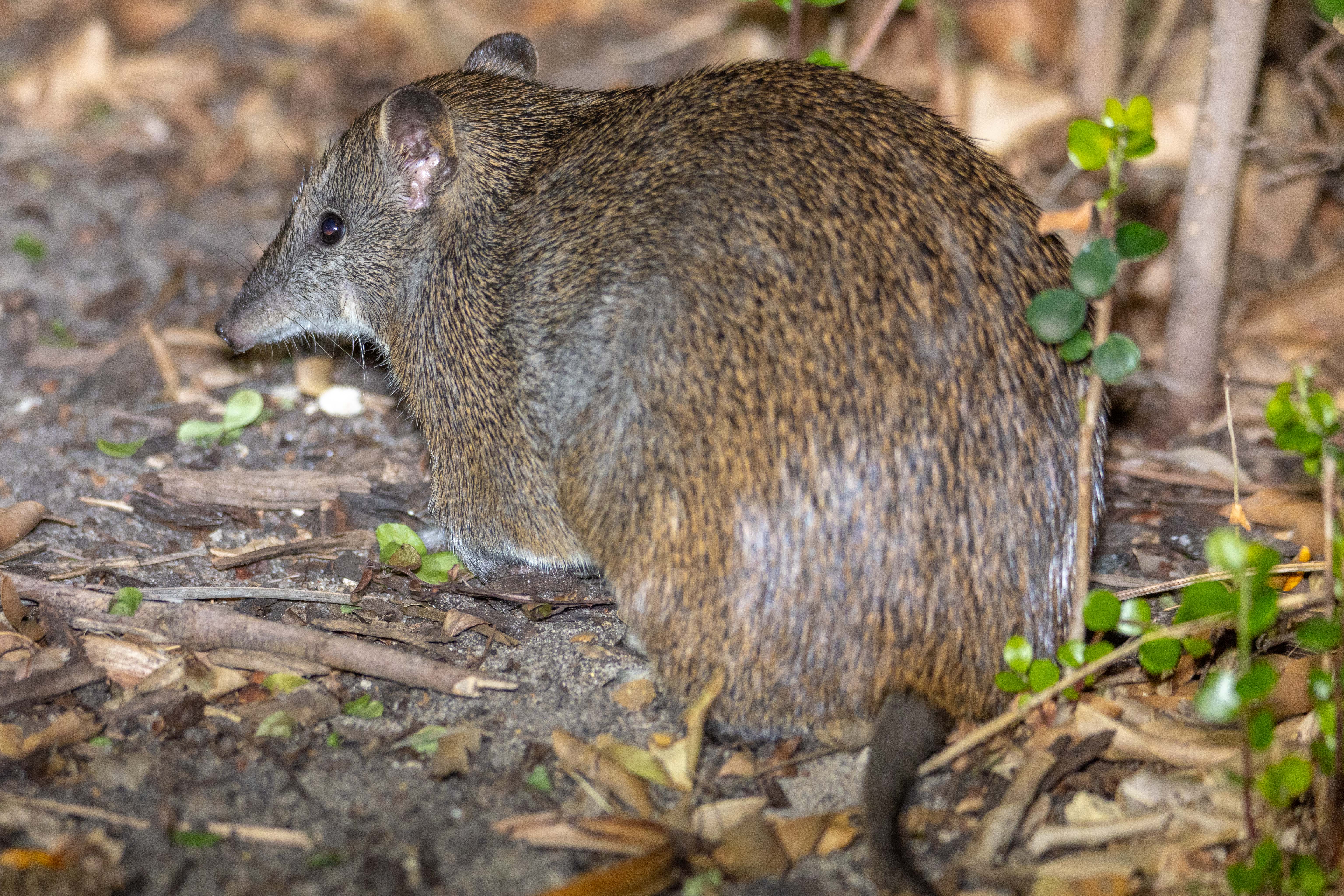
Quenda (bandicoot) have held on in remnant bushland patches across the Perth suburbs. I’ve found them at Piney Lakes, Craigie Bushland, Perth Hills and Victoria Gardens in East Perth – nose-down in the leaf litter, apparently indifferent to the suburb ten metres away, still doing the same job of turning soil and dispersing seeds that they’ve done on this coastal plain for thousands of years.
Quokkas persist on Rottnest Island – the island population never having faced mainland fox pressure – and in small scattered mainland patches including Perth Hills, Canning Dam, Jarrahdale through to Albany. They are not the broad ranging population of 1829, but they are there.
Western grey kangaroos (yongka) graze the ovals and parklands of the outer suburbs, largely indifferent to us. They were here before us and they’ve found a way to persist alongside us, at least where enough open space remains.
Western ringtail possums (ngwayir) cling on in pockets of peppermint woodland from Busselton south. I’ve written about the extraordinary colony in Busselton – critically endangered but present, holding on. The brushtail possum is more adaptable and turns up in suburban gardens across Perth.

Echidnas (nyingarn) turn up in outer suburban gardens, trundling through with magnificent indifference. I see them regularly at Dryandra and they still occasionally appear where there are portions of bush – an animal so armoured and specialised that it has managed, just about, to survive the waves of change that took so many others.

Tammar wallabies (dama) thrive on Garden Island (HMAS Stirling) – I had an extraordinary evening with them there that I’ve written about at length – and other populations persist at Tutanning Nature Reserve and other wheatbelt reserves. They are living proof of what the Swan Coastal Plain once held.

Black-flanked rock-wallabies (moorang) persist in the granite outcrops of the Darling Scarp, within reach of Perth if you know the right sites. I’ve written about also finding them in the wheatbelt – cautious, beautiful animals sheltering in the same rock formations their ancestors have used for millennia.
And in the reserves – Dryandra, Boyagin, Tutanning, and others – with the right conditions and enough patience: Numbats, Woylies, Chuditch, Red-tailed and Brush-tailed phascogales, echidnas. Animals that were ordinary features of the Boorloo landscape 200 years ago, now requiring effort and planning to find.
One place you can see many of these animals together is Barna Mia Nocturnal Wildlife Experience at Dryandra Woodland National Park. Many animals that now exist only on islands or in fenced reserves can be seen here. This video shows the amazing assemblage of animals.
None of this is to say things are fine. They’re not. Every one of these populations exists within a narrowed range, under ongoing pressure, dependent to varying degrees on active human management. The quokka’s mainland populations wouldn’t be viable without fox control. The numbat wouldn’t survive at Dryandra without ongoing baiting programs. The woylies at Tutanning need predator management to persist and there are only a few left. The Western ringtail possum is losing habitat year by year but recently new populations have been found. These animals are survivors – but they are surviving on the edge, and the edge keeps getting narrower.
There is also something worth knowing about reserves. Research has shown that feral cats and foxes are just as effective inside national parks and nature reserves as they are anywhere else – the boundary on a map means nothing to a predator. What actually protects animals is active, ongoing management: baiting, fencing, translocation and protecting/expanding habitat & corridors. Not lines drawn on paper.
Looking at the Landscape Differently
There is a particular feeling I get sometimes when I’m out at night in a patch of remnant bush near Perth. I’ve been driving tracks for hours, spotlight out, thermal camera scanning – and suddenly there’s a quenda nosing through the leaf litter, or an echidna trundling across the path, or a possum glaring at me from a branch. I can see glimpses of what was here before.
I find that if I hold the historical knowledge in my head while I’m doing this – if I allow myself to think about what else should be in this landscape, what was once here – those moments become deeper and more layered. Not sadder, exactly. More weighted. More significant.
In 2029, Western Australia will mark 200 years since the founding of the Swan River Colony. It will be a complex anniversary. For many people it will be a genuine celebration – 200 years of a society built, of families established, of cities grown from nothing. For Noongar people it marks 200 years of dispossession, displacement, and the severing of custodial relationships with country that had been maintained for an unimaginably long time. For the wildlife, it marks 200 years of extinctions, contractions and diminishment.
All of these things are true simultaneously, and I think the 200-year mark is an opportunity to hold them together honestly rather than looking away from any of them.
Something I keep coming back to, from the research: the rate of loss hasn’t actually slowed. About four or five Australian species have been lost per decade since 1788, and that’s still roughly where we are now. All the reserves, all the legislation, all the management effort – it may be preventing things from getting worse faster, but the losses keep coming. That’s not a reason to give up. It’s a reason to take it more seriously.
The crescent nailtail wallaby is gone. The boodie is gone from the mainland. The bilby no longer occurs in the south-west. The wetlands that once made this coastal plain one of the most biodiverse landscapes in Australia are mostly drained and buried under suburbs.
But the quenda is still in the suburban bush. The quokka is still on Rottnest. The numbat is still at Dryandra. The echidna still appears in gardens.
If you want to see them get out there. Take your kids. Sit in the dark and wait. It is worth it, every time. And while you’re there, allow yourself to imagine what this place once was – and what it might still become, if we choose to take it seriously.
If you want to find some of these species yourself, I’ve written detailed guides to wildlife watching around Perth and across WA – see the Where to See Wildlife in Western Australia. The Numbat guide, the Quokka guide and the Garden Island post are good starting points.
This post took a number of years to write – partly because the research kept pulling me in new directions, and partly because I kept stopping to think about what it all means. I’d genuinely love to hear your response to it in the comments below.
Frequently Asked Questions
What animals lived in Perth before European settlement?
Before the Swan River Colony was founded in 1829, the area now occupied by metropolitan Perth and its surrounds supported an extraordinary diversity of mammals, reptiles, frogs and birds. Species included numbats, woylies, boodies (burrowing bettongs), bilbies, quokkas, tammar wallabies, black-flanked rock-wallabies, western ringtail possums, brushtail possums, quenda (bandicoots), western grey kangaroos, echidnas, and the now-extinct crescent nailtail wallaby. Many of these species have been lost from the Perth region entirely, though some are still around if you know where to look; others survive only in managed reserves or on predator-free islands.
What is Boorloo?
Boorloo is the Whadjuk Noongar name for the area around what is now central Perth, particularly the area near the slope down to the Swan River (Derbarl Yerrigan). The Whadjuk Noongar people are the traditional custodians of this country and managed the land and its resources for tens of thousands of years before European colonisation.
Why did so many animals disappear from the Perth region after 1829?
The decline happened in several overlapping waves: the introduction of livestock and the end of Indigenous cultural burning immediately after settlement; the spread of the red fox (which reached WA in the late 1800s) and its catastrophic impact on medium-sized marsupials; feral cats; and the systematic clearing of native vegetation for agriculture and urbanisation. More than 80 per cent of the wetlands on the Swan Coastal Plain have been drained or degraded since settlement, removing critical habitat for frogs, waterbirds and the mammals that depended on wetland-edge vegetation.
What is the critical weight range and why does it matter for WA wildlife?
Ecologists Andrew Burbidge and Norman McKenzie coined the term ‘critical weight range’ to describe the marsupials most vulnerable to fox and cat predation: medium-sized, terrestrial species weighing between 35 grams and 5.5 kilograms. Almost every species I spend my nights looking for falls into this category – woylies, quokkas, numbats, bilbies, phascogales, bettongs, bandicoots. They are perfectly sized prey for a fox and have no evolutionary history of dealing with this kind of predator.
Is the crescent nailtail wallaby extinct?
Yes. The crescent nailtail wallaby (Onychogalea lunata) is the only macropod to have gone extinct on the Australian mainland in modern times. It was present across much of southern Australia, including the Perth region, in the 1800s. The last confirmed specimen was collected in the 1950s. Fox predation and habitat loss are the primary causes of its extinction.
Where can I see wildlife near Perth today?
Despite the losses, some remarkable wildlife remains accessible near Perth. Quenda can be found at Piney Lakes, Craigie Bushland and other urban reserves. Quokkas are reliably seen on Rottnest Island. Tammar wallabies thrive on Garden Island. Numbats are seen with some regularity at Dryandra Woodland (about 160km from Perth). See my Where to See Wildlife in Western Australia page for a full index of locations and species.
What is the WA bicentennial and when is it?
Western Australia’s bicentennial – 200 years since the founding of the Swan River Colony – falls in 2029. It is an occasion that carries very different meanings for different communities: for many settlers’ descendants, a celebration of 200 years of society-building; for Whadjuk Noongar and other Aboriginal people, a marker of 200 years of dispossession and disruption; and for those who care about wildlife, an opportunity to honestly reckon with 200 years of ecological loss and to recommit to protecting what remains.
Sources and further reading:
- Abbott, I (2001) Aboriginal names of mammal species in south-west Western Australia CALM Science 3(4):433-486
- Abbott, I. (2008). Historical perspectives of the ecology of some easily overlooked vertebrate species of the Northern Jarrah Forest, southwestern Australia. Conservation Science Western Australia
- Abbott, I (2006) Mammalian faunal collapse in Western Australia, 1875-1925: the hypothesised role of epizootic disease and a conceptual model of its origin, introduction, transmission, and spread. Australian Zoologist 33 (4): 530-561
- Glauert, L. (1950). The development of our knowledge of the marsupials of Western Australia. Journal of the Royal Society of Western Australia, 34, 115-134
- Warburton, N.M. (2014). Relicts, reproduction and reintroductions – a century of marsupial research in Western Australia. Journal of the Royal Society of Western Australia, 97, 65-85
- Ford, F (2014) John Gould’s Extinct and Endangered Mammals of Australia
- Grey, B (2021) Extinct: Artistic Impressions of Our Lost Wildlife
- City of Perth / Curtin University: Karla Yarning – Aboriginal Heritage in the City of Perth Before 1829 and After 1829 (heritage trail maps)
- Project Numbat: www.projectnumbat.org
- Cats have helped 27 Australian species to extinction – Invasive Species Blog 12/07/2024
- Woinarski et. al. (2015) Ongoing unraveling of a continental fauna: Decline and extinction of Australian mammals since European settlement Proceedings of the National Academy of Sciences Vol 112, Issue 15, Pg 4531-4540
- Woinarski et. al. (2019) “Reading the black book: The number, timing, distribution and causes of listed extinctions in Australia” Biological Conservation, Vol 239
You can also follow along on Facebook and Instagram for more regular updates between posts.

Leave a Reply