
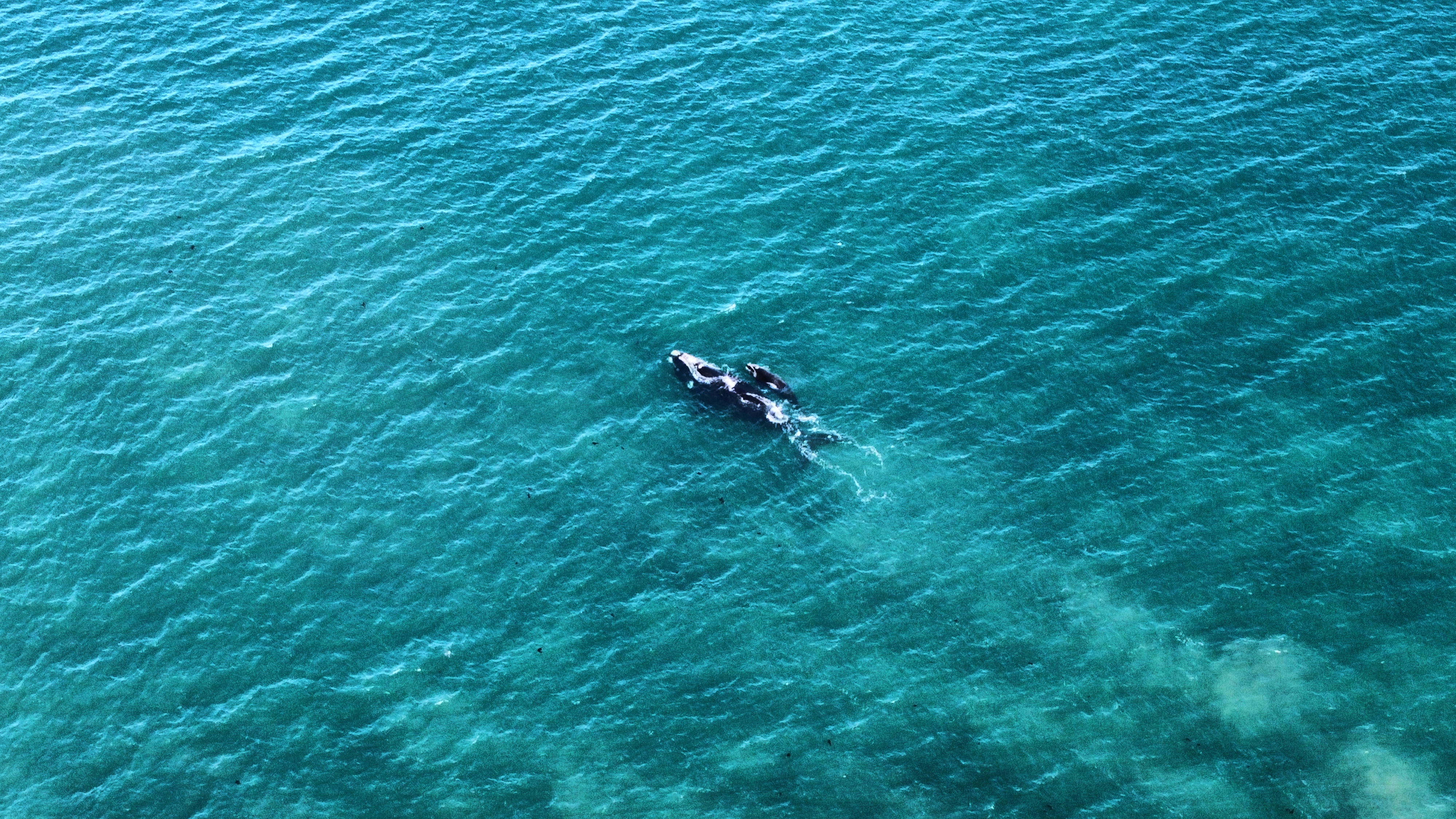
Word had been going around on social media that a Southern Right Whale and her calf had been spotted off the Perth coast. I had a free day, so I grabbed the camera and drone and headed straight to South Cottesloe to find them. I didn’t have to wait long.
They were moving south, staying close to shore, and I walked from South Cottesloe nearly all the way to Leighton Beach keeping pace with them. They were faster than you’d expect – there was a point where I had to walk briskly just to keep up. The mum and calf stayed close together the whole time, the calf surfacing regularly alongside her.
There were a few people in the water on paddleboards and kayaks who moved closer for a look – which is understandable, it’s hard not to want to get as close as possible to something like that. The whales were mostly unbothered, continuing south at their own pace. But it’s worth knowing the WA regulations: vessels must not approach within 100m of a whale, and must not approach from behind or within a 60 degree arc of the whale’s direction of travel. People in the water must also stay at least 100m away. Getting too close, even with good intentions, can cause real stress to animals that are already under significant environmental pressure.
I flew the drone at 100m altitude – well above the minimum legal distance of 60m for remotely piloted aircraft around whales in WA. From above the size difference between mum and calf really hits you. She was enormous!
Here are the shore and water-level shots and video:
And the drone footage:
A rare sighting off Perth
Southern Right Whales are not the whale you expect to see off Perth. September is whale season on the WA coast, but it’s almost always Humpbacks (Megaptera novaeangliae) that pass through on their northward migration. Southern Rights breed and calve further south. Their traditional strongholds are the Great Australian Bight, Israelite Bay, Point Ann and Point Charles along the WA south coast, well east and south of Perth.
Seeing one, let alone a mum and calf, this far north along the coast felt significant. It might just be a wandering individual following favourable conditions, but it’s also possible it reflects something broader about the species gradually returning to parts of its historical range. Before industrial whaling essentially wiped them out in the Southern Hemisphere, Southern Rights would have been a regular sight off the Perth coast. Seeing one here in 2025, with a healthy calf no less, felt like a small glimpse of what might once have been normal.
The conservation story – recovery that’s now stalling
Southern Right Whales (Eubalaena australis) were hunted to the edge of extinction. By the mid-20th century, commercial whaling had reduced the Australian population to perhaps a few hundred animals. The species has been protected in Australian waters since 1935, and the population began recovering – slowly – from that low point.
Researchers have been conducting aerial surveys along the south Australian coastline since 1976, building one of the longest continuous whale datasets in the world. The early decades showed genuine recovery. But more recently the picture has become concerning. A 2026 survey by Murdoch University recorded 520 whales across the south-west, including 235 cow-calf pairs – down from 646 individuals and 304 calves the year before, and 20 per cent below counts from a decade ago.
Perhaps most worrying is what’s happening to calving cycles. Southern Rights historically calved roughly every three years. Long-term data now shows that interval extending to five years – meaning females are producing calves far less frequently than they once did. Researchers believe the cause is linked to ocean warming and its impact on Antarctic krill, the primary food source for these whales. Less sea ice means fewer krill; fewer krill means females arrive at their breeding grounds in poorer body condition and are less likely to successfully conceive and carry a calf.
It’s a sobering reminder that protecting a species from hunting is necessary but not sufficient. The climate pressures now bearing down on these animals are beyond the reach of any single conservation measure. See the full ABC article for the latest survey results.
How to tell a Southern Right from a Humpback
The two species are quite different once you know what to look for. Southern Rights are stockier and darker, with a distinctive absence of a dorsal fin – their backs are completely smooth. The giveaway from shore or drone is the callosities – rough patches of hardened skin on the head that appear white or cream due to whale lice living in them. Each whale has a unique callosity pattern, which is how researchers identify individuals. They also have a very distinctive V-shaped blow when viewed from above or head-on. Humpbacks have a small dorsal fin, longer pectoral fins, and are more likely to breach dramatically.
Whale watching rules in WA
Worth summarising the WA regulations since they came up on this encounter. If you are within 300m of a whale:
- Vessels must not approach within 100m, and must not approach from behind or within a 60 degree arc of the whale’s direction of travel
- If a whale approaches your vessel, remain at 100m with motor in neutral, or move slowly away at less than 6 knots
- Abandon all interaction at any sign of distress – diving for prolonged periods or swimming evasively are warning signs
- People in the water must stay at least 100m from a whale
- Drones and remotely piloted aircraft must stay at least 60m from a whale
I flew at 100m altitude – well above the drone minimum – and the whales showed no sign of disturbance throughout. The key principle in all cases is that you must not cause the animal to change its behaviour. Getting footage is never worth stressing an animal that is already under significant environmental pressure.
Southern Right Whale FAQ
Can you see Southern Right Whales off Perth?
It’s unusual but not impossible – this September 2025 sighting at South Cottesloe shows they do come this far north occasionally. Humpback Whales are the species most reliably seen off Perth during the winter migration season (July to November). Southern Rights are far more commonly seen further south along the WA coast at locations like Israelite Bay and Point Ann, or at the Head of Bight in SA.
When is whale season in Perth?
Humpback Whales migrate north past Perth from around June-July, reach their northern breeding grounds in the Kimberley and Ningaloo by September, then return south from around October to December. September-October can be particularly good for watching from the coast or taking a whale watching tour from Fremantle. Southern Rights travel the south coast from around May through September.
Are Southern Right Whales endangered?
Yes – they are listed as Endangered in Australia. The Australian population was reduced to a tiny fraction of its historical size by commercial whaling and has been recovering since protection in 1935. However, the recovery has stalled since around 2011 and calving rates are now declining, likely due to the impacts of ocean warming on Antarctic krill – the whales’ primary food source.
How do you identify a Southern Right Whale?
Look for a large, rotund, mostly black whale with no dorsal fin – the smooth back is the key feature. Cream or white callosities (rough skin patches) on the head are diagnostic. The blow is V-shaped when seen from ahead or behind. They tend to be slower-moving than Humpbacks and less acrobatic, though calves in particular can be playful. White or partially white calves are not uncommon in this species.
Where is the best place to see Southern Right Whales in WA?
The traditional hotspots in WA are Israelite Bay, Point Ann and Point Charles along the south coast – all significantly east of Perth. The Head of Bight in SA is perhaps the most reliable location of all for land-based viewing, with a purpose-built viewing platform. These areas are where the species congregates to breed and nurse calves from May through September.
Further Reading
- Humpback Whale Watching off Perth — tips on where and how to see Humpbacks from the WA coast
- Blue Whales of Perth Canyon — another extraordinary WA whale encounter
- Perth Pelagic Birdwatching Trip — offshore seabirds and an unexpected Orca sighting off Rottnest
- Whales and Dolphins of WA — full cetacean hub page
- Where to See Wildlife in Western Australia — full location index
You can also follow along on Facebook and Instagram for more regular updates between posts.

Leave a Reply