
The next leg of the trip took us deep into the Tasmanian northwest – Loongana, Mountain Valley Wilderness, and a stop at the Tasmanian Arboretum near Devonport. This is where the trip peaked for me personally: two nights of platypus on the river, Tasmanian devils at the cabin, a spotted-tail quoll that appeared briefly and brilliantly, glow-worms underground, and a pink robin in the rainforest.
The Tasmanian Arboretum, near Devonport – Platypus Stop
We drove from Swansea to Mountain Valley in a single day, via Perth and Launceston, and on the way we stopped at the Tasmanian Arboretum just outside Devonport – a tip from the owners of our Swansea cottage, who told us: “lots of platypus during the day, four or five of them.”
We had to stop by this sign and I got a photo – we are from Perth, Western Australia so it was a novelty to see Perth in Tassie!

I want to share this spot as I don’t believe it’s as widely known as it deserves to be. The Arboretum is a beautiful not-for-profit botanical garden – entry is $10 per adult as of 2026 (children under 18 are free) – set on about 66 hectares with a network of walking tracks around lakes and along Melrose Creek. The trees are organised by geographic origin – Gondwana, North America, Europe, Asia – but to me the wildlife is the real draw.


We walked around the lakes with Mel, Liam and Sienna on a warm day at 22 degrees. Within a few minutes at the lakeside: a platypus (Ornithorhynchus anatinus), surfacing in the middle distance, diving, surfacing again. It was moving quickly – platypus are often frustrating subjects because they spend more time underwater than above it – but we got good prolonged views as it worked along the edge of the manmade lake towards the natural creek system.

The below images show the sequence of diving and disappearing to feed. You could guess where they were from bubbles and plumes of muddy water.


This was another lifer for me and we were all excited to see a unique Australian monotreme. This animal when first seen by Western colonisers confounded the experts; the beak of a duck, body of an otter, tail of a beaver and lays eggs – they thought it may be a taxidermy hoax and looked for stitch marks on the specimens sent to Europe!
We also captured the video – it’s quite interesting to know that while they are below the surface they are feeding on aquatic invertebrates on the lake bed but to eat the food they need to be on the surface and also to breathe!
There is also a hide to watch the birds and platypus.

We would have loved to see a platypus waddle over this crossing but not this time.

The kids were patient and focused – travel with eight and six year olds who have spent many days looking for animals tends to produce excellent little wildlife watchers by the end of the trip. We could have stayed longer (my notes say “could have been more”) but the drive to Mountain Valley was still ahead.
One other thing to mention was the kids burnt off some energy chasing the turbo chickens who could have flown if they were really concerned.
The homemade ice cream at the kiosk was, as my notes record with enthusiasm, “yum.”
There were a number of birds seen and here are a few of the images.


Mountain Valley Wilderness, Loongana – The Main Event
Mountain Valley Wilderness is a small eco-lodge deep in the Loongana area of northwestern Tasmania, roughly four to four and a half hours’ drive from Hobart (and about an hour south of Devonport). It sits on a private property in rainforest country with the Leven River running through it, which makes it superb platypus habitat, and the owners run a Tasmanian devil feeding program that has been operating for more than 20 years, according to our host.
I’d booked this specifically for the devils and platypus. What I didn’t know was that another predator would also turn up.
We arrived at about 4:30pm after the family handled the long day’s drive from Swansea (via Perth, Launceston and the Arboretum) really well. Checked in, settled into the cabin, and immediately started exploring the property. The rainforest here is beautiful – tall, mossy, cool even in January. Pademelons were visible at the bush edge as it became evening.
The owners gave us clear instructions: don’t go out after dark as you’ll scare the devils and contaminate the feeding area with human scent. They put out the food – chicken wings, Maryland pieces and a big bone – and I set up the trail camera near the feeding station, ready for dark at around 9:30pm.
Platypus on the Leven River
At 8pm we headed down to the river with my camera. Within minutes: two platypus, one on the far bank, one working the near bank – swimming, diving, surfacing, completely at home in the water.

Brown trout were also visible in the river – good-sized fish holding in the current. The combination of old-growth rainforest, a clear cold river, platypus and trout, and the light fading was just amazing. So nice to be in an isolated valley and looking forward to the evening’s wildlife!


The Devils Arrive
Back at the cabin. It got dark about 9:30pm. The kids were awake and watching through the window. The cabin had a lamp near the food station – dim enough not to disturb too much, bright enough to see.
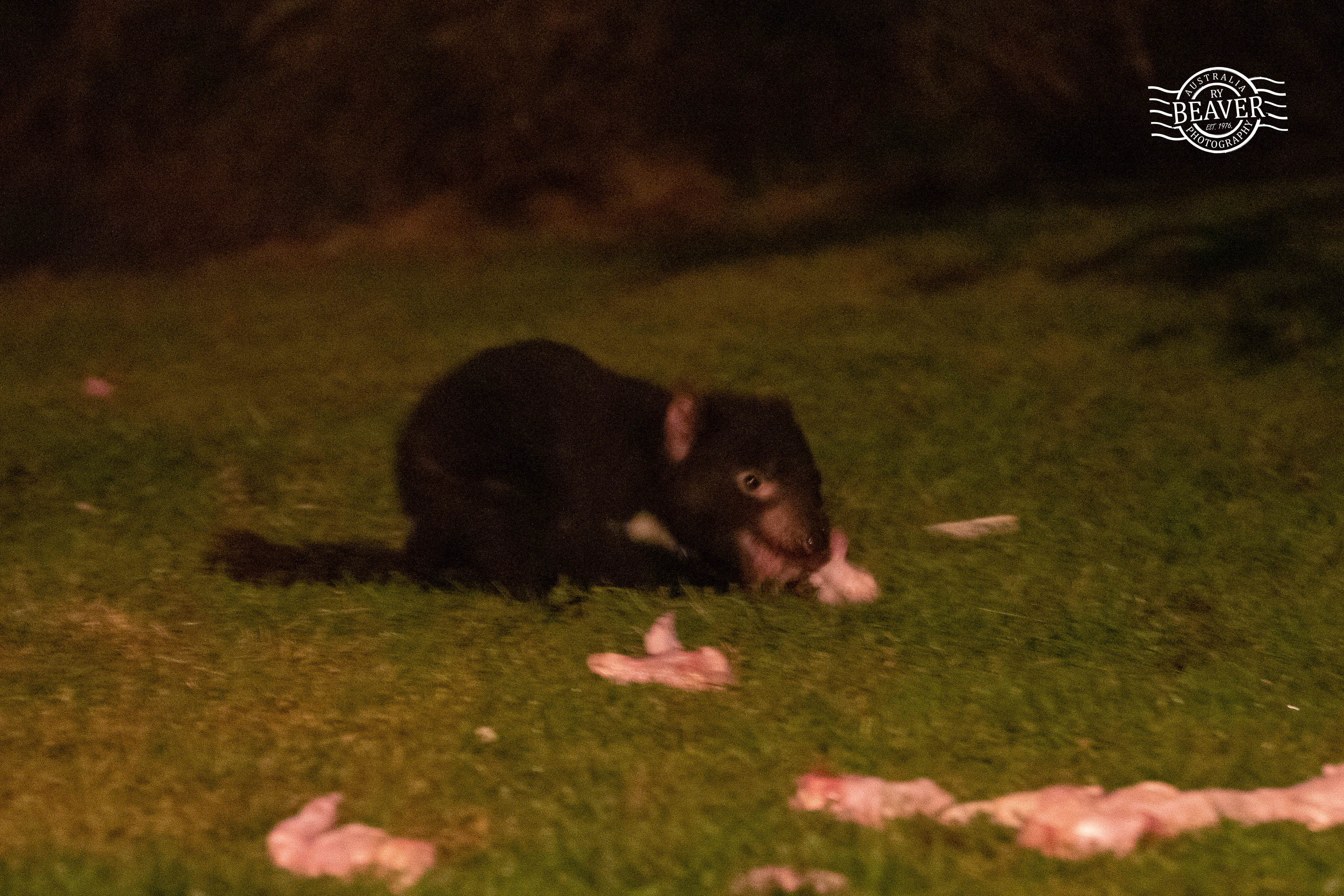
My notes from this night are slightly chaotic and I love them for it: “Tasmanian devil – black possum, are boys – rats??” That’s me just enjoying what we had the privilege of experiencing. They don’t look like anything I’ve seen before. The Tasmanian devils (Sarcophilus harrisii) are stocky, low-slung, with a large head and short thick tail. Black, mostly, with white flashes. The first one arrived at about 10:30pm – came straight for the chicken, grabbed a piece and retreated. Then it came back. Then another one arrived.

And then, at 11:05pm: a spotted-tail quoll (Dasyurus maculatus), the largest carnivorous marsupial on the Australian mainland (and second only to the devil in Tasmania), appeared at the feeding station, snatched a piece of chicken, and disappeared into the dark before I could do much more than fire the camera and stare. Unfortunately the kids had flaked out by this time but Mel and I shared the sighting together!
3 more lifers in one day for the trip – remembering I saw my first Platypus on this day as well.

At around 11:30pm a larger devil arrived and settled in. This one stayed. It ate methodically – bone, fur and all, exactly as advertised – making the wild range of sounds that devils make when feeding: grunts, snarls, that high-pitched screech when another animal came too close. We went to bed at midnight with a bone and three pieces of chicken left, and the owners told us in the morning that the visits had continued until about 4am. My notes: “photography hard” – an understatement, trying to photograph a black animal at night in low light without flash is properly challenging, but I got some shots I’m happy with.


The second night was similar: platypus again from 8pm with brown trout, first devil at 9:40pm, video off the trail camera. No spotted-tail quoll on the second night. But the devils were reliable and the whole experience – family together at the cabin window, watching by lamplight as these incredible animals came out of the rainforest to feed – is one of the best wildlife memories of my life. We also had pademelons and Bennett’s wallabies feeding on the lawn throughout the night.
Here is a series of videos from the trail camera – it shows a snippet of how good the viewing was!
The Glow-Worm Cave
During the day at Mountain Valley we visited the glow-worm grotto on the property – a small cave system in the forested hillside above the cabin. Tasmanian glow-worms (Arachnocampa tasmaniensis) are bioluminescent larvae of a small fungus gnat, found in caves and rock overhangs throughout Tasmania. In the complete darkness of the cave they produce a soft blue-green light – hundreds of them across the roof – and the effect is magical. No photos can do it justice (the light level is too low for anything but very long exposures), but if you stay at Mountain Valley this is not to be missed. The kids loved the climbing, the glow-worms and the cave spider we spotted.


Birds: Pink Robin and Yellow-Tailed Black Cockatoos
I need to mention two birds from Loongana because they were special.
Pink robin (Petroica rodinogaster) – a tiny bird, the male with a vivid hot-pink breast against a black cape. I found one in the rainforest near the cabin, working low in the understorey in that characteristic robin way – flitting, pausing, watching me. It’s one of those birds that looks too bright to be real, like someone has gone a little crazy with paint. A real highlight.

Yellow-tailed black cockatoos – we saw these beautiful birds feeding down near the bridge over the river, just a short walk from our cabin to a public picnic spot. Very different from the white-tailed and red-tailed black cockatoos we have back home in Western Australia.


We also saw many other birds, including a laughing kookaburra (introduced to Tasmania), a black currawong, a Tasmanian brown thornbill (the Tasmanian subspecies of the brown thornbill, Acanthiza pusilla diemenensis) and a grey shrikethrush.


The snake!
On one of the days we headed out to explore and for a little civilisation – we went to a place that had lovely gardens and Devonshire tea – we really enjoyed it. On our return we had a visitor just outside our cabin – a snake. Now normal people might be quite concerned but our wildlife-focused family are different. We wanted to make sure we got a good look and could see what it was! 🙂
It was a Lowland copperhead (Austrelaps superbus) – one of three snakes found in Tasmania. It was enjoying a sunny spot and, after we all got a good look from a safe distance, we left it alone and it moved off later that day.


The cabins and surrounds
Mountain Valley Wilderness is a really special place. Len our host was so helpful – stopping by for chats and giving lots of wonderful advice. He was also really good with kids with all their questions. He is really passionate about the area and protecting wildlife, especially devils. There are six cabins and there were other people staying in another cabin but we didn’t really come in contact with them. It is quite a remote location, so you need to bring all your own supplies. The cabins are basic, but have all you need, and the wildlife and forest make the place.
If you’d like to have the same experience, we’d happily recommend it. Their nightly price includes an evening platypus tour, a night-time wildlife experience (where we watched the devils and the quoll) and a tour of the glow-worm grotto and self-guided walks through the forest habitat – the main things described in this post. Their Flora cabins sleep up to six with a bunk room, which suits families, and at the time of writing were $295 per night with a two-night minimum (Nov 2026). Details and availability are on the Mountain Valley Wilderness website.


Coming in Part 4
From Mountain Valley we headed for Strahan via Cradle Mountain – captive devils at Devils@Cradle, eagles and an echidna from the car window, a tiger snake by a stream, and the long drive back to Hobart. Part 4 also has the whole trip in review: the lifers, the family highlights and the complete species list.
Read the full series:
- Part 1 – Bruny Island and the Night of the Quolls
- Part 2 – Waterworks Reserve, Maria Island and Wombats for the Kids
- Part 3 – Devils, Platypus and Glow-Worms at Mountain Valley Wilderness
- Part 4 – Devils at Cradle, Strahan and Tasmania Trip Wrap-Up
Species seen in this part
Mammals: Platypus, Tasmanian devil, Spotted-tail quoll, Tasmanian pademelon, Bennett’s wallaby, Common brushtail possum, Black rat (introduced, probable)
Birds: Pink robin, Yellow-tailed black cockatoo, Superb fairywren, Black swan, Chestnut teal, Eurasian coot, Tasmanian native hen, Black currawong, Brown thornbill, Grey shrikethrush, Laughing kookaburra (introduced)
Reptiles: Lowland copperhead
Other: Tasmanian glow-worm, Cave spider, Brown trout (introduced)
Tasmania Part 3 – Devils and Platypus FAQ
Where can you reliably see Tasmanian devils in the wild?
Mountain Valley Wilderness in Loongana has been feeding wild Tasmanian devils for more than 20 years, according to our host, and guests can watch them visit a feeding area near the cabins. The light was enough for us to see by but not so bright that it disturbed the animals. It’s a far more reliable way to see devils than random encounters, though sightings are never guaranteed, so check with the owners when you book. Cradle Mountain’s visitor precinct also has captive devils on display if you want guaranteed daytime views (see Part 4).
What time of day are platypus most active?
Platypus are normally most active around dawn and dusk, but at the Tasmanian Arboretum near Devonport we saw them out during the day. At Mountain Valley they were most visible from around 8pm.
How do you tell a spotted-tail quoll from an eastern quoll?
Spotted-tail quolls are noticeably larger – the largest carnivorous marsupial on the Australian mainland, and second only to the Tasmanian devil in Tasmania – and their spots extend onto the tail, not just the body. Eastern quolls, seen on Bruny Island, are smaller with plain unspotted tails.
Where can you see Tasmanian glow-worms?
Glow-worms live in caves and rock overhangs across Tasmania, including a small cave system on the Mountain Valley Wilderness property near Loongana. They need complete darkness to be visible, so avoid using torches once inside.
How far is Mountain Valley Wilderness from Hobart?
Roughly four to four and a half hours’ drive, and about an hour south of Devonport, in the Loongana area of Tasmania’s northwest, on the Leven River.
What is included when you stay at Mountain Valley Wilderness?
At the time of writing (November 2026), the Mountain Valley Wilderness website says the nightly price includes an evening platypus tour, a night-time wildlife experience where you can see wild Tasmanian devils, and a tour of the glow-worm grotto and forest habitat. Their Flora cabins sleep up to six and were $295 per night with a two-night minimum, rising to $300 from 1 January 2027. Check their website for current prices and availability.
You can also follow along on Facebook and Instagram for more regular updates between posts.

Leave a Reply